What a Bench Warrant in Mississippi Means for You


xxx A bench warrant in Mississippi is a court-issued order authorizing law enforcement to arrest someone for failing to comply with certain court requirements, most commonly failing to appear for a scheduled hearing. Mississippi Code § 99-5-25 addresses bench warrants issued when defendants fail to appear while released on bond. Probation violations are governed by separate procedures under § 47-7-37. Unpaid fines or fees may also lead to court proceedings, but a person cannot automatically be jailed simply because they cannot afford to pay. The legal requirements depend on the reason the warrant was issued.
The immediate risk is real: a bench warrant can surface at the worst possible time, during a routine traffic stop, at a workplace background screening, or when you’re pulled over for something as minor as a broken taillight. Felony nonappearance warrants get entered into NCIC, which means the exposure isn’t limited to Mississippi.
Here’s what to do right now:
Call the county clerk’s office where your case was filed and ask directly whether a warrant exists.
Contact the sheriff’s warrant division for confirmation and next steps.
Call Big Man Law before you do anything else that could put you in handcuffs unexpectedly.
Key Takeaways
Resolving a Mississippi bench warrant fast and correctly depends on official verification, understanding the 90-day judgment nisi clock, and getting counsel involved before attempting surrender.
Point | Details |
Verify through official channels | Call the county clerk or sheriff’s warrant division directly rather than trusting third-party search sites. |
Know your triggers | Section 99-5-25 addresses failure to appear while on bond. Probation violations are governed by § 47-7-37, while unpaid court obligations are subject to separate procedures and protections. |
Watch the 90-day clock | Appearing within the judgment nisi window can prevent full bond forfeiture. |
Never surrender alone | Coordinated courthouse surrenders through counsel reduce time in custody and improve outcomes. |
Call Big Man Law | Joey Franks brings over a decade of Mississippi criminal defense experience to recall motions, bond negotiation, and probation revocation defense. |
Table of Contents
Understanding a Bench Warrant Under Mississippi Law
Mississippi law lays out the mechanics plainly. Under Mississippi Code § 99-5-25, when a defendant fails to appear as required, the court enters a judgment nisi and issues a bench warrant for that person’s arrest. That statute also governs bond forfeiture, which is why missing court doesn’t just risk arrest. It can cost you or your bondsman money too.
Bench warrants and related court-issued arrest warrants may arise in several circumstances:
Failure to appear: Missing a required court date can result in a bench warrant and, when applicable, bond-forfeiture proceedings.
Probation violations: A court may issue an arrest warrant for an alleged probation violation under Mississippi Code § 47-7-37. Probation officers also have statutory authority to make certain arrests without a warrant.
Failure to comply with court orders: Courts may take enforcement action when someone violates a lawful order. However, nonpayment of fines, fees, or restitution requires consideration of the person’s ability to pay and applicable legal protections before incarceration.
A bench warrant is not the same thing as an arrest warrant. An arrest warrant typically requires police to present a judge with fresh probable cause tied to a new alleged crime. A bench warrant, by contrast, flows from noncompliance with something the court already ordered, and it’s also distinct from a search warrant, which authorizes searching property rather than arresting a person. Felony nonappearance warrants get entered into the National Crime Information Center database, which is why an old Mississippi warrant can follow you across state lines.
How to Check for an Active Warrant in Mississippi
Checking for outstanding warrants in Mississippi comes down to going straight to the source instead of trusting a search engine result. Here’s the order that actually works:
Call the county clerk’s office where your case was filed. Give them your name and, if you have it, your case number. Ask directly whether a bench warrant has been entered and what court issued it.
Contact the county sheriff’s warrant division. Sheriff’s offices execute warrants locally, and many county sites, including Jackson County’s warrant search page, publish contact information for exactly this purpose.
Understand where warrants actually live. The Mississippi Department of Public Safety’s Criminal Information Center (MJIC) supports the databases law enforcement uses to check wants and warrants, along with driver’s license data. These systems exist for police queries, not public lookup portals, which is exactly why an officer at a traffic stop can find a warrant you didn’t know existed.
Be careful with third-party “warrant search” websites that charge a fee or claim instant results. Many pull outdated or incomplete records, and a clean result from one of those sites means nothing if the county clerk’s own file says otherwise.
Pro Tip: A standard commercial background check often won’t catch an active bench warrant, because those services rarely pull live warrant databases. A clean background check is not the same as a clear warrant, so verify with the county directly before you assume you’re in the clear.

What Happens If You Have an Active Bench Warrant
An active bench warrant in Mississippi carries consequences well beyond the courtroom. The most immediate is arrest exposure: any contact with law enforcement, a traffic stop, a welfare check, even a report you file as a victim, can end with you in custody on the spot.
Bond forfeiture is the financial side of the equation. Once the court enters a judgment nisi under § 99-5-25, the clock starts running toward full forfeiture of the bond, and that hits sureties and bondsmen hard if the case drags on unresolved.
An outstanding Mississippi warrant may also create problems outside the state. Under Mississippi Code § 99-5-25, felony nonappearance warrants must be entered into the National Crime Information Center (NCIC) database. Other warrants may also be entered into law enforcement databases, depending on the agency and applicable requirements. Whether an out-of-state officer can arrest someone and whether Mississippi will seek extradition depend on the warrant, the offense, and the circumstances.
Beyond the legal mechanics, an outstanding warrant creates real disruption:
Unexpected arrest can mean missed work, missed childcare, and a scramble to explain an absence you didn’t plan for.
Driver’s license complications can follow certain traffic-related warrants, compounding an already stressful situation.
Standard background checks often miss active warrants entirely, which means the surprise usually comes at the worst possible moment, not during routine screening.
How to Clear a Bench Warrant in Mississippi
Resolving a bench warrant is a process, and doing it in the right order matters more than doing it fast.
Verify the warrant formally. Get the case number, the issuing judge’s name, and the county of record from the clerk’s office or sheriff’s warrant division. Guessing gets you nowhere here.
Weigh voluntary surrender against waiting. Turning yourself in on your own terms is often viewed favorably by judges and lets you control timing, location, and who’s with you. Waiting to be arrested means losing that control entirely, often in front of coworkers, family, or during a routine stop.
Bring in an attorney to file a motion to recall or quash. An attorney can often arrange a courthouse surrender, walking you directly to arraignment or a bond hearing rather than a holding cell, which can dramatically shorten time in custody.
Address bond forfeiture within the judgment nisi window. The judgment nisi runs for a limited statutory period, and appearing within that period can prevent full forfeiture. Courts have accepted documentation like hospital records, jail records showing incarceration elsewhere, or proof of enrollment in a certified rehab program as grounds to set the forfeiture aside.
Prepare for surrender properly. Bring identification, any case paperwork you have, and contact information for your attorney. Coordinated surrenders through counsel tend to move faster than walk-ins, since the court and clerk already know you’re coming.
Pro Tip: Never attempt to walk into a courthouse alone to “clear things up” without counsel present. A recall motion filed incorrectly, or a surrender handled without coordination, can mean sitting in custody for days waiting on a hearing that an attorney could have arranged same-day.
Timelines and Defenses That Can Work in Your Favor
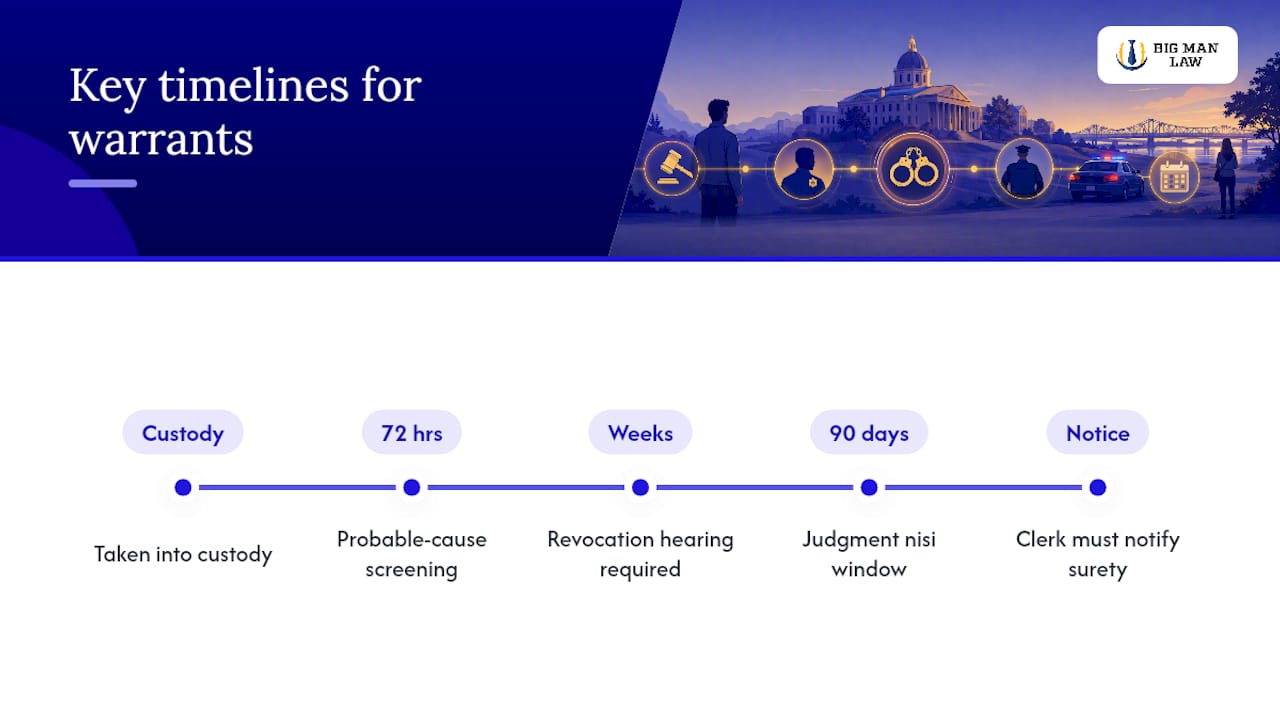
Under Mississippi Code § 99-5-25, a judgment nisi in a bond-forfeiture proceeding is returnable within 90 days after issuance. If the defendant appears in court or is arrested and surrendered during that period, the judgment nisi must be set aside. The statute also provides additional protections after a final forfeiture judgment, including a 90-day stay of execution and circumstances in which the forfeiture can still be set aside. Probation-revocation proceedings follow different deadlines under § 47-7-37. When a probationer is arrested on a qualifying violation warrant, a preliminary hearing generally must occur within 72 hours unless an exception applies. A revocation hearing generally must occur within 21 days of detention, and a separate 30-day deadline measured from issuance of the warrant applies unless good cause for delay is established.
Notice requirements matter too. The clerk must notify the surety within a short notice period after a judgment nisi is entered, and failure to give that notice can create grounds to set the forfeiture aside entirely.
Missing a statutory deadline can have significant consequences, but the remedy depends on which deadline was violated. Under § 99-5-25, failure to provide timely notice to the surety can support setting aside the bond-forfeiture order. Under § 47-7-37, missed probation-revocation deadlines may require release from detention or dismissal of the revocation charge, depending on the circumstances. These protections do not automatically invalidate every outstanding arrest warrant.
Attempting to file a motion to quash or recall without a lawyer present carries real risk. Showing up at the courthouse to argue your own case can result in immediate custody before the motion is even heard.
Big Man Law Handles Bench Warrant Cases Across Mississippi
Once you’ve confirmed a warrant is active, the next call matters more than the next hour you spend worrying about it. Big Man Law focuses on getting Mississippi clients through the exact process outlined above: filing motions to recall or quash, arranging organized courthouse surrenders instead of surprise arrests, negotiating bond terms, and defending against probation revocation when that’s what triggered the warrant in the first place.

Attorney Joey Franks, known around Jackson and Ridgeland as “the Big Man,” has spent more than ten years handling Mississippi criminal defense cases, including the DUI and drug possession matters that generate a large share of bench warrants in this state. That experience means Big Man Law knows which judges accept which forms of documentation for a forfeiture set-aside, and how to arrange a surrender that gets you to a bond hearing instead of a holding cell for the weekend.
If you’re preparing to call, have your case number, the county where charges were filed, and any documentation tied to why you missed court, medical records, incarceration records, or program enrollment proof. From there, Big Man Law can map out whether a motion to quash, a bond renegotiation, or a coordinated surrender fits your situation best. Start by reaching out through Big Man Law’s defense strategies page to get a clear read on your options before that warrant turns into an unplanned arrest.
Official Mississippi Resources on Bench Warrants
Your county’s court clerk and sheriff’s office pages
This article is general information, not a substitute for advice from a qualified lawyer. Consult a qualified legal professional about your own circumstances before acting on anything here.
Sources
Recommended
Comments