License Deadlines Matter: DUI vs Public Intoxication in Mississippi


A DUI is the more serious charge in Mississippi, and it isn’t close. Public intoxication under Miss. Code §97-29-47 is a misdemeanor capped at a $100 fine and 30 days in jail. A DUI under Miss. Code §63-11-30 can strip your driving privileges, follow you on background checks for years, and turn into a felony fast if someone gets hurt. If you’re facing a DUI, call a lawyer today. The clock on your driving license is already running.
TL;DR:
Public intoxication charges are limited to a $100 fine and 30 days in jail, with no impact on driving privileges, provided fewer than two people witness the behavior.
Evidence for public intoxication relies solely on officer observation, while DUI proof includes chemical tests, with strict calibration and chain-of-custody requirements.
Administrative license suspensions for DUI start immediately upon arrest, with a typical 90-day suspension for refusal and a 30-day temporary permit, separate from the criminal case.
Prosecutors treat DUI cases more seriously than public intoxication, with DUI court procedures involving multiple legal and administrative tracks that require quick legal action to protect driving rights.
Table of Contents
Public Intoxication vs. DUI in Mississippi: A Side-by-Side Look
The two charges get confused constantly because both involve alcohol, but they measure completely different things. Public intoxication asks whether you were visibly drunk and disorderly in front of other people. DUI asks whether you operated a vehicle while impaired, and it doesn’t care whether anyone witnessed you stumbling.
What the state must prove: Public intoxication requires drunkenness or vulgar conduct in a public place with two or more people present. DUI requires proof you were operating a vehicle with a BAC over the legal limit or otherwise impaired.
Penalty ceiling: Public intoxication tops out at a $100 fine and 30 days in jail. First-offense DUI can mean fines, jail time, and mandatory license suspension, with felony exposure for repeat or aggravated cases.
License impact: Public intoxication typically has zero effect on your driver’s license. A DUI almost always does, through implied consent rules and post-conviction suspensions.
When they overlap: Someone arrested for a DUI who also acts belligerent at the scene can pick up a public intoxication charge on top of it, but the DUI is what dictates the long-term damage to your record and your ability to drive.
What Is Public Intoxication in Mississippi?
Under §97-29-47, it’s unlawful to be drunk, or to use profane or vulgar language, in a public place while two or more people are present. That “two or more persons” detail matters. A person passed out alone in their own backyard hasn’t violated this statute, even if they’re intoxicated.
“Public place” gets applied broadly in practice, covering bars, sidewalks, parking lots, and parks. Because there’s no breath test involved, the charge rests entirely on an officer’s judgment call about your behavior and speech.
Fine of up to $100
Jail time of up to 30 days
Possible additional charges depending on what else happened at the scene
Quick fact: Mississippi’s public intoxication fine has stayed capped at $100 for years, a fraction of what a first-offense DUI fine can run once court costs and fees are added.
What Is a DUI in Mississippi?
Miss. Code §63-11-30 makes it illegal to operate a vehicle while under the influence of alcohol or drugs, or above set blood alcohol thresholds. “Operate” doesn’t just mean driving down the highway. Courts have found people guilty of DUI for sitting behind the wheel of a parked, running car.
The BAC thresholds vary by who’s driving:
.08 for adult drivers
.04 for commercial drivers
.02 for drivers under 21 (Mississippi’s zero-tolerance standard for minors)
A first-offense DUI in Mississippi carries fines, the possibility of jail time, and a mandatory alcohol safety education course through MASEP. Many first offenders also face ignition-interlock requirements before full driving privileges return. The real escalation comes with repeat offenses or aggravated DUI, where someone is seriously hurt or killed. Aggravated DUI convictions can carry mandatory minimum prison terms of several years per victim, according to the Mississippi Bar Association, pushing what started as a traffic stop into felony territory.
License Consequences: Implied Consent, Suspensions, and Ignition Interlock
Driving on a Mississippi road means you’ve already agreed to chemical testing if an officer has probable cause to suspect impairment, as explained in implied consent laws in Florida that highlight similar legal principles. That’s implied consent, and it applies the moment you get behind the wheel. Refuse the test, and you’re typically looking at an automatic administrative suspension of about three months for a first refusal, according to the Driver Service Bureau, regardless of whether you’re ever convicted of the underlying DUI.
A conviction brings its own suspension, separate from the refusal penalty, and commercial drivers face additional restrictions on top of that. The Driver Service Bureau’s FAQ guidance lays out the mechanics: temporary driving permits are generally valid for 30 days, and license suspensions tied to a court order commonly begin 21 days after that order is entered.
Implied consent applies the moment you drive on a public road
First refusal: typically a 90-day administrative suspension
Temporary permits: generally valid for 30 days
Court-ordered suspensions: commonly begin 21 days after the order
Pro Tip: Don’t wait for your court date to deal with your license. The administrative suspension clock and the criminal case run on separate tracks, and missing an appeal deadline on the administrative side can cost you driving privileges even if the criminal charge eventually gets resolved in your favor.
How Arrests and Evidence Differ Between the Two Charges
A public intoxication arrest hinges entirely on what the officer sees and hears. There’s no chemical test involved. Slurred speech, staggering, or shouting profanity in front of a crowd is typically enough for an officer to make the call, which is exactly why these charges can be easier to contest on factual grounds. What looks like drunkenness to one officer might have a medical explanation the police report never captures.
DUI evidence works differently. It starts with probable cause for the stop, moves through field sobriety tests, and often ends with a breath or blood test that has to follow strict calibration and chain-of-custody procedures.
Preserve dashcam and bodycam footage before it’s routinely deleted
Get contact information for any witnesses at the scene
Request copies of testing calibration records and the full police report
What to Do After a Public Intoxication or DUI Arrest
The first hour after an arrest shapes everything that follows. Handle it wrong, and you hand the prosecutor evidence they wouldn’t otherwise have.
Stay quiet beyond basic identification. Anything said after the arrest can end up in the police report and get used against you later.
Ask for an attorney immediately, whether you’re charged with public intoxication, DUI, or both at once.
Write down witness names and numbers while memories are fresh, especially anyone who can speak to your behavior or sobriety.
Preserve medical records if a health condition, medication, or injury could explain symptoms an officer read as intoxication.
Ask about non-adjudication eligibility. Under §63-11-30, some first-time DUI defendants can qualify for a program that withholds a formal conviction if conditions are met, though eligibility rules are specific and don’t apply to everyone.
For public intoxication, defenses often focus on whether you were genuinely in a “public place” with two or more people present, or whether the conduct even rose to the level the statute describes. For DUI, the fight is usually over the stop itself, whether you were actually “operating” the vehicle, or whether the breath or blood test can hold up under a chain-of-custody or calibration challenge.
Pro Tip: If you’re offered an ignition-interlock-restricted license while your case is pending, ask your attorney whether accepting it now protects your ability to drive to work later. That decision often needs to happen fast, before deadlines close the door on it.
Big Man Law: Local DUI Defense Experience in Jackson
Attorney Joey Franks has spent over 10 years building Big Man Law around one focus: fighting DUI charges for people in Jackson and across Mississippi. That kind of narrow focus matters, because DUI cases turn on details a general practice attorney might skim past.
A typical case review starts with pulling dashcam and bodycam footage, checking whether the stop itself held up, and scrutinizing whether breath or blood testing followed proper procedure. From there, the firm looks at whether non-adjudication or a negotiated resolution can keep a conviction off your record, or whether the case needs to go to a hearing to protect your license.
Bring your citation, any paperwork from the stop, and a rundown of what happened to your first consultation. That’s enough to start mapping out where the case is vulnerable.
Public Intoxication vs. DUI: How Often Do Mississippi Courts See Each?
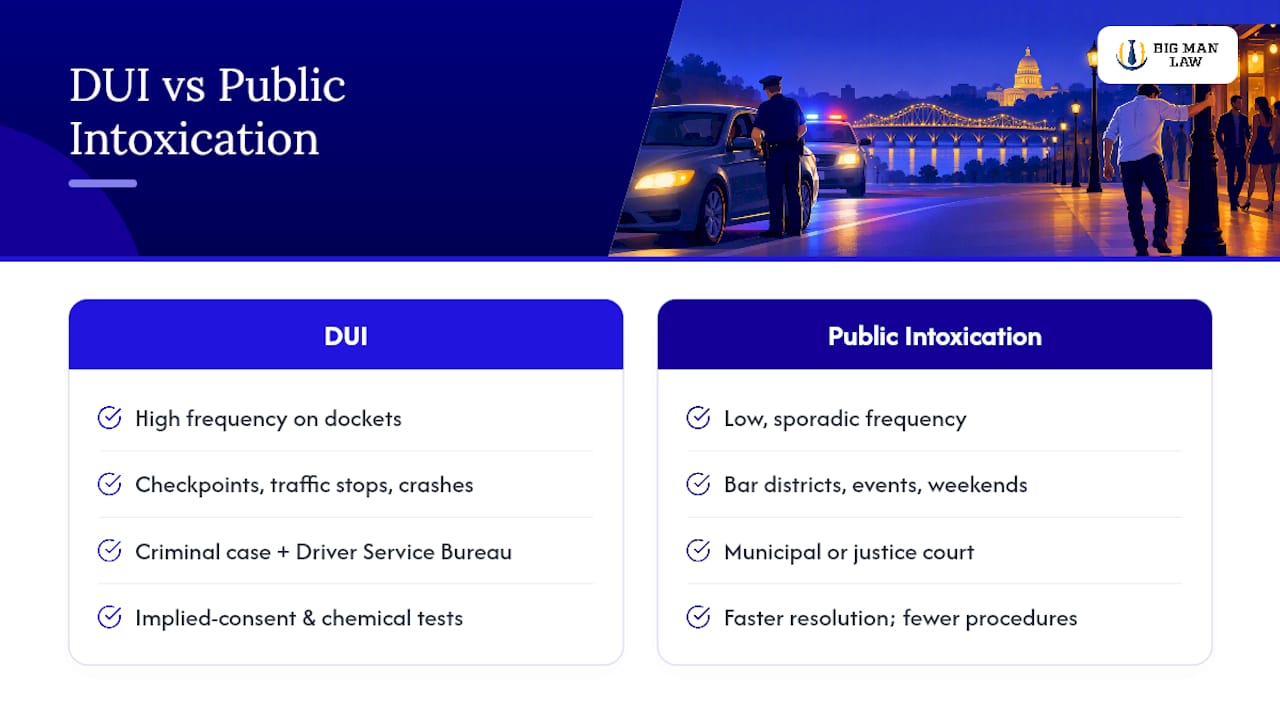
DUI arrests dwarf public intoxication citations across Mississippi’s court dockets, largely because law enforcement treats impaired driving as a public safety priority in a way that outpaces enforcement of simple drunkenness in public. Highway patrol checkpoints, traffic stops, and crash investigations generate a steady stream of DUI arrests. Public intoxication, by contrast, tends to show up more sporadically, often tied to bar districts, football weekends, or festivals where large crowds and heavy drinking overlap.
That enforcement pattern shapes how each charge gets treated once it lands in court. DUI cases get funneled through processes built specifically around implied consent, chemical test evidence, and administrative license actions, because the volume demands it. Public intoxication cases, being less frequent and lower stakes, often move through municipal or justice courts more quickly, with less procedural weight attached.
For someone charged with public intoxication, this usually means a faster resolution and a narrower range of possible outcomes. For someone charged with DUI, it means stepping into a system with far more moving parts. There’s the criminal case in front of a judge, and there’s a parallel administrative process at the Driver Service Bureau, both running on their own timelines. Miss it on either track, and you lose ground you can’t easily get back.
The volume difference also affects how seriously each charge gets treated by prosecutors day to day. A public intoxication charge is often the kind of case a prosecutor is willing to reduce or dismiss as part of resolving a bigger incident. DUI cases rarely get that same treatment, because the political and public safety pressure around impaired driving keeps prosecutors from letting them go quietly.
Court Procedures: Public Intoxication vs. DUI
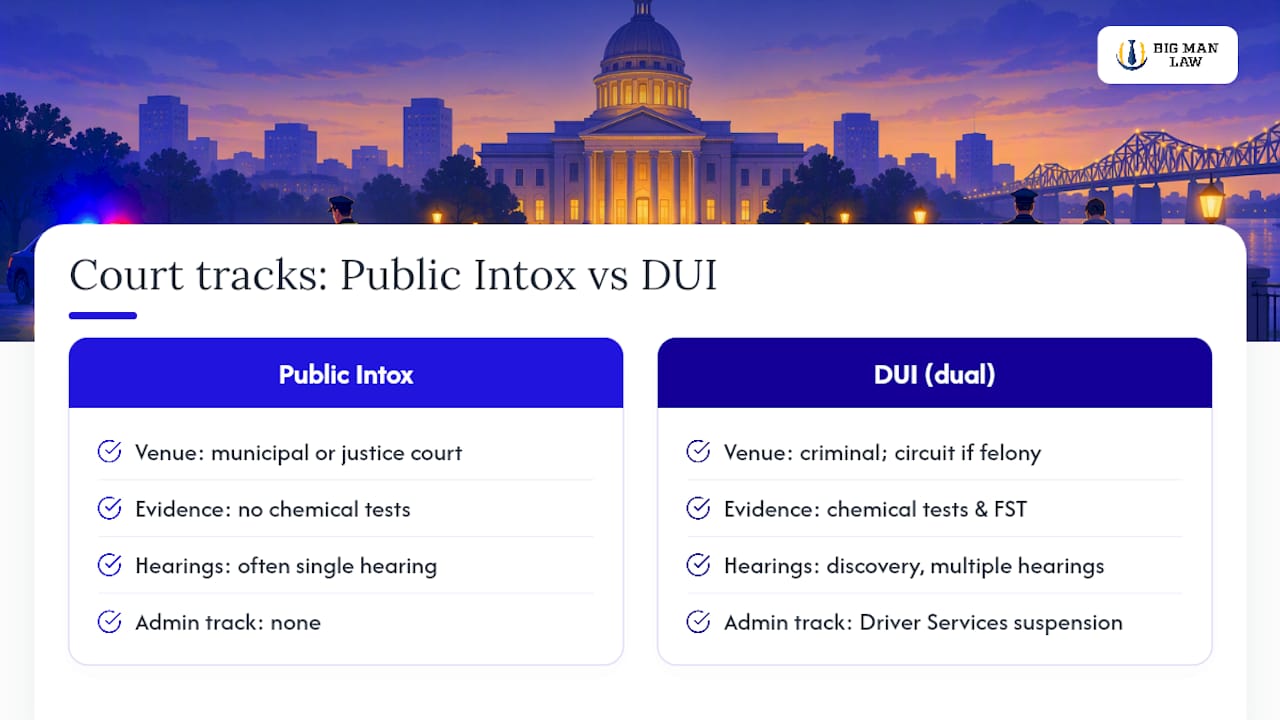
Public intoxication cases typically move through municipal or justice court, the same venues that handle minor misdemeanors like disorderly conduct. There’s usually no jury trial demand, no chemical evidence to litigate, and often a single hearing resolves the matter, sometimes with a plea to a reduced charge or a fine.
DUI cases are procedurally heavier from the start. Beyond the criminal court appearance, there’s the separate administrative process tied to your license, arbitration over field sobriety and chemical test results, and, for aggravated or repeat cases, the possibility of a grand jury indictment and felony-level proceedings in circuit court. Discovery in a DUI case often includes dashcam footage, breathalyzer maintenance logs, and officer training records, none of which come into play in a typical public intoxication matter.
The dual-track nature of DUI cases is what trips people up. Handling the criminal charge without addressing the Driver Service Bureau’s administrative suspension timeline can mean losing your license even after winning in court. Public intoxication carries no such parallel process, which is part of why it resolves faster and with less at stake procedurally.
Long-Term Record Impact: Public Intoxication vs. DUI
A public intoxication conviction is a misdemeanor that shows up on a background check, but its practical weight tends to fade. Most employers and landlords treat it as a minor blemish rather than a red flag, particularly if it’s an isolated incident with no pattern behind it.
A DUI conviction carries far more weight, and it sticks around. It’s a criminal conviction that appears on background checks indefinitely in Mississippi absent expungement, and repeat offenses compound quickly. A second DUI within five years brings harsher mandatory penalties than a first, and a third can trigger felony classification with substantial prison exposure. Aggravated DUI, where serious injury or death results, is a felony outright, with the kind of mandatory minimum sentences described earlier that can permanently alter someone’s life.
Non-adjudication, where available for qualifying first-time DUI cases, offers a real path to keeping a conviction off the record entirely if conditions are met. That option doesn’t exist in the same form for repeat DUI offenders or for most aggravated cases, which is exactly why acting fast after a first arrest matters so much.
Rehabilitation and Diversion Options for Offenders
Mississippi builds several off-ramps into its DUI framework, mostly aimed at giving first-time offenders a way to avoid a permanent conviction while still holding them accountable. The Mississippi Alcohol Safety Education Program, MASEP, is a mandatory education course for most first-offense DUI defendants, and completing it is often a condition of resolving the case.
Non-adjudication is the bigger prize for eligible first offenders. Under §63-11-30, a court can withhold a formal finding of guilt and place a defendant under specific conditions, and successful completion means no DUI conviction lands on the permanent record. Eligibility rules are narrow, generally limited to first offenses, so this isn’t a guaranteed option for everyone who gets arrested.
Ignition-interlock-restricted licenses function as a middle path for people who need to keep driving to work or handle family obligations while their case or suspension plays out. Public intoxication carries no comparable formal diversion structure. Because it’s a lower-level misdemeanor, resolutions tend to happen informally, through a reduced fine, a plea, or in some cases a dismissal negotiated alongside other charges from the same incident.
Insurance and Employment Fallout: Public Intoxication vs. DUI
Insurance carriers care almost exclusively about your driving record, so a public intoxication conviction, which never touches your license, usually leaves your auto insurance rates untouched. A DUI conviction is a different story entirely. Insurers treat it as a major red flag, and premium increases after a DUI conviction are common and often substantial, sometimes pushing drivers into high-risk insurance pools for years.
Employment consequences follow a similar split. A public intoxication conviction rarely derails a job application unless the role involves specific licensing requirements or a heightened background standard. A DUI conviction is a bigger obstacle, particularly for jobs that require driving, handle vulnerable populations, or need professional licensing, since many licensing boards ask directly about criminal convictions involving impaired driving.
The gap widens further for commercial drivers. A DUI can jeopardize a commercial driver’s license outright, threatening the livelihood of anyone whose job depends on being legally allowed behind the wheel. That’s one more reason the two charges, despite both involving alcohol, land in completely different weight classes when it comes to your future.
Talk to Big Man Law Before Your License Deadlines Close
Facing a DUI in Mississippi puts you on two clocks at once: the criminal case and the administrative suspension tied to your license. Big Man Law is built around exactly that pressure point, offering focused DUI defense in Jackson rather than treating it as one case type among many.
A consultation with Big Man Law starts with a review of your citation, the police report, and any available dashcam or bodycam footage, followed by an honest read on your timeline. That includes flagging implied-consent deadlines and the 30-day window on your temporary permit before it lapses, since missing either can cost you driving privileges before your case is even heard. The firm’s consultation fee is $100, a flat starting point for getting real answers instead of guessing at what comes next.
Contact Big Man Law promptly after an arrest. The administrative suspension clock doesn’t pause for anyone, and the sooner an attorney reviews your stop, your test, and your paperwork, the more options stay open for protecting your license and your record.
This article is general information, not a substitute for advice from a qualified lawyer. Consult a qualified legal professional about your own circumstances before acting on anything here.
Sources
FAQ
Is Public Intoxication as Serious as a DUI?
No. Public intoxication is capped at a $100 fine and 30 days in jail, and it typically has no effect on your driver’s license. DUI carries heavier fines, possible jail time, mandatory license suspension, and felony exposure for repeat or aggravated cases.
What Is the Legal Definition of Public Intoxication in Mississippi?
Under §97-29-47, it’s unlawful to be drunk or use profane or vulgar language in a public place while two or more other people are present. There’s no chemical test requirement; it’s based entirely on observed behavior.
Is a DUI a Felony in Mississippi in 2026?
A first or second DUI is typically a misdemeanor, but a third offense or an aggravated DUI involving death or serious injury is a felony under §63-11-30. Aggravated DUI can carry mandatory minimum prison terms of 5 to 25 years per victim.
Can I Drink a Beer and Drive in Mississippi?
Having a drink before driving isn’t automatically illegal, but operating a vehicle with a BAC of .08 or higher violates §63-11-30 regardless of how impaired you feel. Even one drink can push some drivers close to the legal threshold depending on body weight, food intake, and time elapsed.
How Much Does a DUI Consultation Cost With Big Man Law?
Big Man Law charges a $100 consultation fee to review your case and discuss next steps. That initial meeting covers your citation details, evidence, and the administrative deadlines tied to your license.
Recommended
Comments